
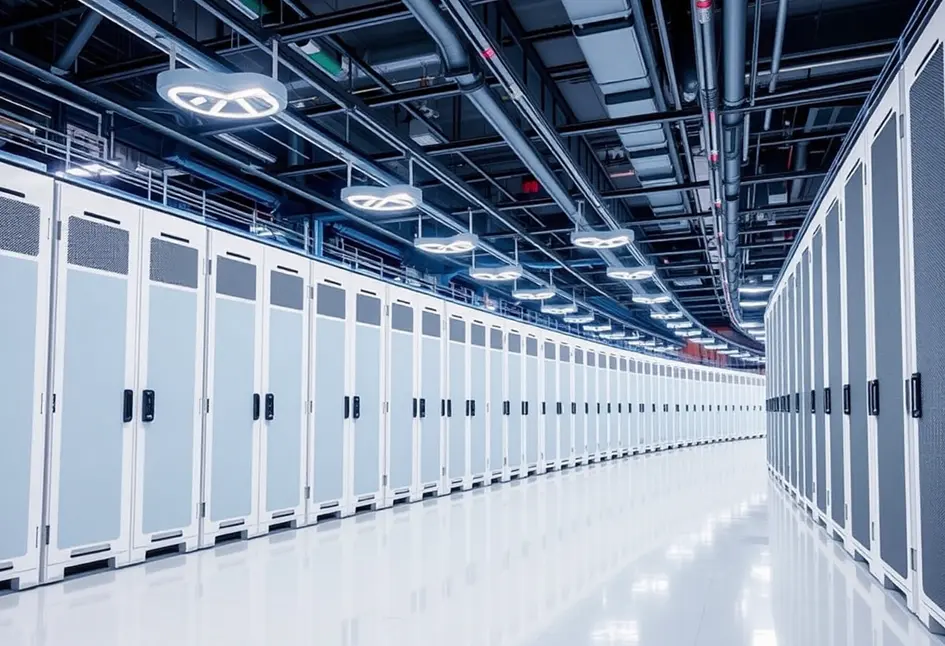

A data center outage can cost large enterprises millions of dollars per hour. A Tier 3 data center guarantees 99.982% availability, while a Tier 4 data center raises the bar to 99.995%. The difference may seem minimal, but it translates into double the investment cost. Learn why most companies rely on colocation services built on Tier 3 infrastructure, when it makes sense to invest in Tier 4, and how data center tier standards affect your costs and operational security.
Choosing the right infrastructure for hosting and data center colocation is much like buying insurance—overpaying means wasting money, while underestimating protection exposes you to existential risk. Some companies pursue maximum redundancy regardless of cost, while others seek a balanced approach between availability and budget. Understanding the distinctions between the different infrastructure tiers helps you get the most out of your investment in data services.
TIER Classification—The Rules of the Game in the Data World
Data center tier standards didn’t emerge by accident—the creation of a unified evaluation system was driven by a market oversaturated with ambiguity and inconsistent definitions of reliability. In 2005, the Uptime Institute introduced a four-tier scale, which today serves as a universal language between providers and customers alike.
The system divides data centers into four levels, labeled Tier I through Tier IV. Each higher level includes all the requirements of the lower ones and adds another layer of protection. Tier I represents basic infrastructure with minimal guarantees, while Tier IV provides full fault tolerance, including protection during planned maintenance.
The evaluation is based on measurable parameters:
- redundancy of critical components,
- number of distribution paths for power and cooling,
- annual availability expressed as a percentage,
- and the maximum allowable downtime per year.
However, this classification is not just for technical comparison. It also defines the economic reality of data center operations and helps companies allocate resources where they truly create value.
Tier 3 Data Center – Reliability Without the Financial Overkill
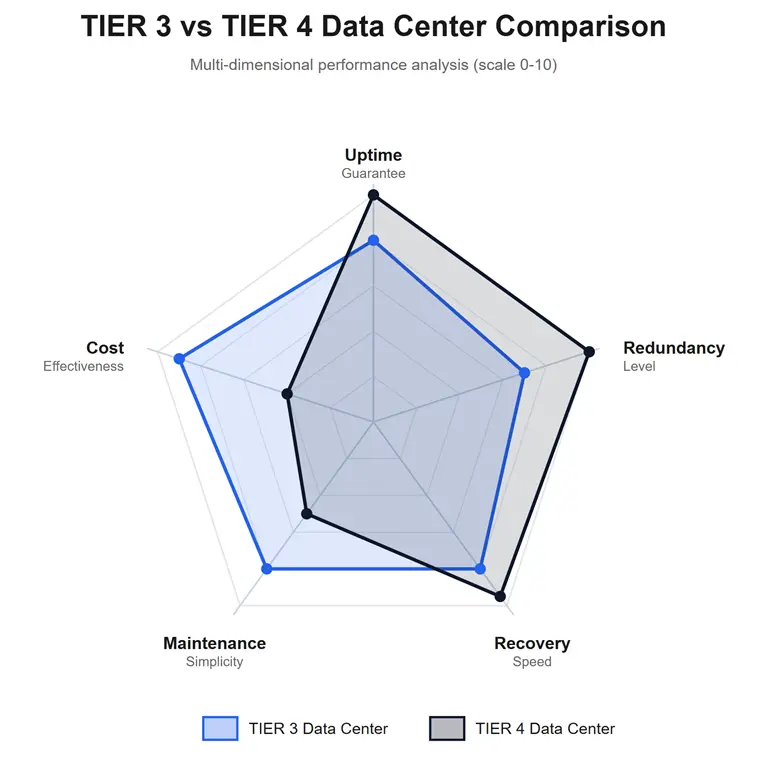
Tier 3 infrastructure dominates the global colocation services market for a good reason. This level guarantees 99.982% annual availability, which in practice means a maximum of 1.6 hours of downtime per year. For context, an average workday lasts eight hours, so the yearly downtime equals roughly one-fifth of a single work shift.
A Tier 3 data center is built on the N+1 redundancy principle. Every critical component—backup power supplies, cooling systems, generators—has at least one reserve unit. It also features multiple distribution paths for both power and cooling, ensuring that planned maintenance does not affect running systems.
The economic advantage lies in a rational approach to protection—it provides sufficient reliability for the vast majority of commercial applications. Businesses with continuous operations, growing data loads, or customers across multiple time zones find here an optimal balance between cost and performance.
The choice of provider depends on the specific business needs and the operator’s ability to maintain declared parameters. A neutral housing provider with long-term experience often offers a higher level of service quality than newly certified entities, because experience in operating and maintaining critical infrastructure has no substitute. For more details about specific parameters and approaches to data center colocation, visit https://ttc-teleport.cz/en/.
Tier 4 Data Center – When Price Is No Longer an Argument
Infrastructure certified as Tier 4 guarantees 99.995% availability, which translates to a maximum of 26.3 minutes of downtime per year. A Tier 4 data center operates on a 2N or 2N+1 redundancy model—every system is duplicated with independent power sources. No single point of failure can disrupt operations, whether during planned maintenance or an unexpected outage.
Such a level of protection naturally requires double the investment cost compared to Tier 3. So who actually needs this kind of infrastructure?
- government institutions processing sensitive data,
- large e-commerce platforms handling transactions worth billions,
- or financial institutions.
For these entities, every minute of downtime represents a loss exceeding the cost of redundant systems.
The Economic Logic Behind Choosing the Right Tier
A Tier 3 data center meets the operational needs of the vast majority of medium and large enterprises. It provides sufficient protection at a fraction of the cost of premium infrastructure. Investment in Tier 4 only makes sense in cases where every second of downtime generates measurable financial losses in the hundreds of thousands.
A proactively managed Tier 3 data center with robust monitoring often outperforms a poorly maintained Tier 4 infrastructure. One principle, however, always holds true: smart budget allocation toward Tier 3 combined with a reliable colocation services provider delivers far better results than an overpriced Tier 4 certification with an unreliable partner.
Decide Smart, Not Expensive
Choosing a data center is a strategic decision that impacts both your cash flow and business competitiveness. For most companies, the optimal solution lies in a professionally operated Tier 3 infrastructure—offering significantly lower costs while still providing excellent protection against outages.
Also Read-Trusted Business Reputation: A Must for Local Businesses