
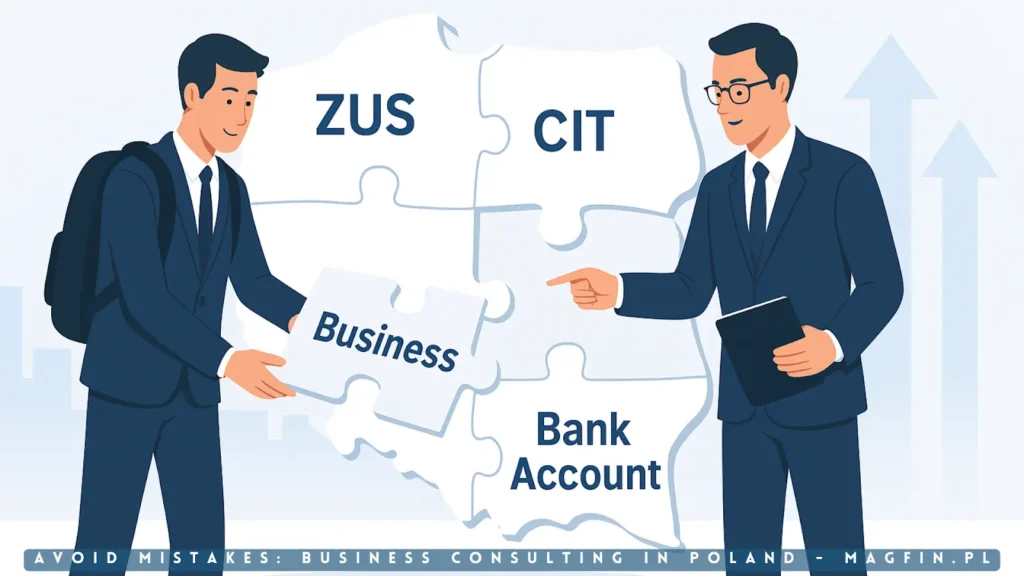

Starting your own business in a new country is always a step into the unknown. In addition to obvious questions about the legal form, company name, and share capital, there are many non-obvious but extremely important nuances on which the success and stability of your business depend. Poland, with its dynamically developing economy and favorable investment climate, attracts many entrepreneurs. However, in order not to face unexpected problems, it is extremely important to obtain qualified consultation before starting operations.
Turning to business consulting specialists in Poland is not just a convenience, but a necessity. Professionals with deep knowledge of local legislation and market realities will help you avoid common mistakes and pave the way to effective business management.
Here are three key questions every future entrepreneur in Poland should get answered.
Question 1: What is ZUS and how do social contributions work?
When it comes to doing business in Poland, issues of taxation and profit often come to the forefront. However, the social insurance system — ZUS (Zakład Ubezpieczeń Społecznych) — plays an equally important role. This is a state institution that manages all types of social insurance in the country.
Every entrepreneur operating in Poland is required to make regular contributions to ZUS. These payments include:
- Pension insurance (emerytalne): provides for a future pension.
- Disability insurance (rentowe): covers risks of loss of working capacity.
- Health insurance (zdrowotne): gives the right to free medical care.
- Sickness insurance (chorobowe): voluntary for sole proprietors but mandatory for employees, provides entitlement to payments during sick leave.
- Accident insurance (wypadkowe): covers risks related to workplace injuries.
Why is this important?
Incorrect calculation or late payment of contributions to ZUS can lead to serious fines and penalties. Moreover, ignoring these obligations can become an obstacle to obtaining a residence permit or citizenship in the future. A business consulting specialist will help you understand the complex contribution system, calculate the correct amount, and set up timely payments, saving you from unnecessary problems and financial risks.
Question 2: What taxes need to be paid and how to optimize the tax burden?
Poland’s tax system, like in any other country, has its own specifics. Understanding which taxes need to be paid and in what amount is critically important for the financial health of your business. The main taxes for companies include:
- Corporate Income Tax (CIT, podatek dochodowy od osób prawnych): The main tax for legal entities such as Spółka z o.o. (LLC). The standard rate is 19%, but a preferential rate of 9% is provided for small companies and startups.
- Value Added Tax (VAT, podatek od towarów i usług): The main consumption tax. The standard rate is 23%, but there are reduced rates (8%, 5%) and full VAT exemption for certain types of activities.
- Personal Income Tax (PIT, podatek dochodowy od osób fizycznych): Paid by sole proprietors and individuals on their income.
Why is this important?
Proper accounting and timely tax payments are the foundation of legal and successful business operations. Lack of proper expertise may lead to incorrect calculation of the tax base, which threatens fines and even criminal liability. A professional accountant-consultant will not only help you understand tax legislation but also suggest strategies for optimizing the tax burden by using all available benefits and deductions. This will allow you to save significant funds and direct them to developing your business.
Question 3: How to open a bank account and what is needed for this?
Opening a corporate bank account is one of the final but mandatory steps of company registration. For foreign entrepreneurs, this process may be associated with certain difficulties. Banks require the submission of a complete set of documents confirming the legality of your company and the legitimacy of conducting business in Poland.
Why is this important?
Without a corporate account, you cannot conduct financial operations on behalf of the company: accept payments from clients, pay supplier invoices, and pay employee salaries. Moreover, this is a requirement of tax and regulatory authorities. The process may be long and tedious, especially if you are not familiar with Polish banking procedures.
A qualified consultant will help you:
- Prepare a complete package of documents in accordance with the requirements of the chosen bank.
- Schedule a meeting and, if necessary, accompany you to the bank to speed up the process.
- Explain the specifics of working with the Polish banking system.
Conclusion
Registering a business in Poland is only the beginning. Successful and stable operations require a deep understanding of local legislation, the tax system, and the social security system. Attempting to figure everything out on your own can lead to costly mistakes and wasted time.
That is why, even before starting the registration process, it is so important to seek help from qualified specialists. Professional business consulting is an investment in the future of your company, allowing you to focus on what matters most: developing your business and achieving your goals, while leaving all legal and bureaucratic complexities to the experts.
Also Read-Vidwud AI: Transforming Online Body Swap and Talking Photo Technology